ECHA has added two more SVHC substances to the Candidate List. The changes entail additional activities and information obligations throughout the supply chain.
On February 4, 2026, the European Chemicals Agency updated the Candidate List and added two new substances identified as SVHCs: n-hexane and 4,4′-[2,2,2-trifluoro-1-(trifluoromethyl)ethylidene]diphenol.
These substances may be included on the Authorization List in the future. If a substance is on this list, companies cannot use it unless they apply for authorization and the European Commission authorizes its continued use.
Companies may have legal obligations resulting from the inclusion of a substance on the Candidate List. These obligations, which take effect from the date of inclusion, apply not only to the listed substances on their own or in mixtures, but also to their presence in articles.
What does this mean for businesses?
Verification of substances, mixtures, and also products in their portfolio
Updated safety data sheets for both substances and mixtures containing the listed substances
Changes to product labeling, marking, and packaging
Updated PCN notifications for hazardous mixtures
Communicating changes in the supply chain
Obtaining information on the type and content of SVHC substances in articles
Notifying ECHA and reporting articles containing SVHC >0.1% in the SCIP database
Requirement to inform customers and consumers about the presence of SVHCs in products
The European Union is implementing a plan to reduce the most harmful chemicals through two main strategies on chemicals and the environment. Despite these efforts, projections show that the presence of chemicals and exposure to them will continue to pose challenges for both legislation and public health.
Every day, people in Europe come into contact with polluted air, contaminated food, and water, and are exposed to complex mixtures of chemicals contained in everyday products. Constant exposure to pollutants and certain chemicals is associated with a variety of health effects. Endocrine and neurological disorders, reproductive problems, and cancer are increasingly common in society.
Therefore, over the past few years, the European Union has taken regulatory action to restrict the use of the most hazardous chemicals and reduce exposure levels. Two main strategies have been developed to this end:
1) Zero Emissions Action Plan
2) Chemicals Strategy for Sustainability
Both strategies include reducing the use of pesticides and veterinary antibiotics by at least 50% by 2030 and striving for an environment free of toxic pollutants by 2050.
Despite progress in reducing emissions of some substances, progress in replacing the most harmful chemicals with safer alternatives is inconsistent and difficult to implement in practice. Selected substances, such as heavy metals, bisphenol A, and PFAS, still exceed safe levels in human bodies in much of Europe and pose a potential health risk.
The outlook for the coming years shows a mixed picture – regulations may limit exposure to some chemicals, but cumulative exposure to complex mixtures, the increasing production and import of new substances, and gaps in toxicological data continue to pose a public health challenge.
The European Commission has launched activities aimed at the recycled materials sector, especially plastics sector.
The European Commission has presented a package of measures to support the circular economy, with a particular focus on plastics. The package of measures is divided into two phases. The first consists of rapid, short-term actions to support the circular economy and encourage investment and innovation in environmental protection and waste management. The second phase will focus on ensuring a uniform functioning market for recycled raw materials.
The European Commission’s work includes:
Launching a public consultation on the Single-Use Plastics Directive (SUPD), which will run until mid-March 2026.
Publishing a proposed implementing act to establish EU end-of-waste criteria for plastics. The new legal proposal will clarify the criteria for the reusability of recycled material. The proposal is undergoing public consultation, which will conclude at the end of January.
Referring the implementing act regarding the recycled content in single-use PET beverage bottles to a vote.
Planning the reactivation of the Circular Economy Alliance in the Plastics Sector.
Monitoring the global plastics market, culminating in a summary and development of potential measures to ensure fair competition in the plastics market.
Increasing support for circular economy projects.
The Commission’s actions are intended to accelerate the implementation of the circular economy for plastic materials.
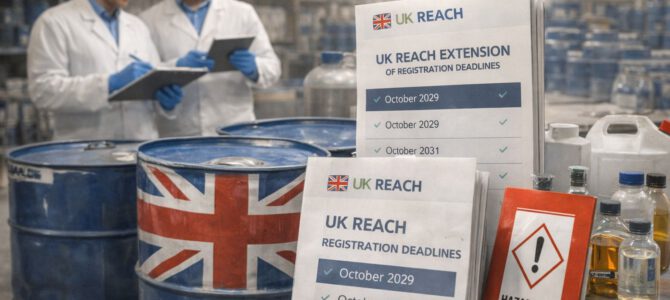
The United Kingdom has decided to extend the deadlines for registering substances under UK-REACH. The new dates are October 2029, 2030, and 2031.
After leaving the European Union, the United Kingdom developed its own chemical legislation and its own registration system [UK-REACH] for chemicals placed on the domestic market. Registrations of chemical substances, depending on tonnage and hazard posed, were scheduled for October 2026, 2028, and 2030. Because the UK government was not fully prepared to implement all planned solutions, it was decided in December 2025 to extend the registration deadlines under UK-REACH. The new dates are:
October 2029
Substances included on the Candidate List before 31 December 2023;
CMR substances in quantities of ≥ 1 tonne per year;
Substances very toxic to aquatic organisms in quantities of ≥ 100 tonnes;
All substances in quantities of ≥ 1,000 tonnes;
October 2030
Substances included on the Candidate List after 31 December 2023;
All substances in quantities of ≥ 100 tonnes;
October 2031
All substances in quantities of ≥ 1 tonne per year.
The amended regulations will be adopted in 2026, following standard parliamentary procedure, to ensure that the new deadlines and compliance arrangements come into force well in advance of the first extended deadline in October 2029. The government also intends to enact regulations for compliance checks, ensuring that they are conducted only after registrants have completed their registration.
The UK-REACH system is modeled on the European regulations with minor changes. It is worth noting that the EU-REACH system remains in force in Northern Ireland.
What does this mean?
Entities placing or importing substances onto the UK market will have more time to prepare for the registration process for substances or substances contained in mixtures.
Thank you for being part of our story in 2025. We look forward to further cooperation and wish you peaceful holidays and a successful new year.
We wish you a wonderful Christmas holiday full of peace, time spent with your loved ones and well-deserved rest. May the new year bring you further successes, interesting opportunities and many reasons to be happy – in both your professional and personal life.
The Council of the European Union has approved the text of the new detergent regulation. Work on adopting the legislation will now be forwarded to the European Parliament.
The Council of the European Union has approved the proposed text of a new regulation on detergents and surfactants, which is intended to update the 2004 provisions contained in the current Regulation (EC) No 648/2004.
The proposed new legislation provides guidelines for the sale of detergents across the European Union. Key changes include:
a ban on animal testing of detergent products;
introduction of regulations on microorganisms and microorganism-based products, which were previously unregulated;
introduction of digital labeling and a digital product passport, which aims to reduce the amount of information on product packaging and increase consumer access to product data;
tighter environmental protection rules, including biodegradability rules;
strengthened product liability for non-EU importers or distributors, who must ensure compliance with EU regulations or appoint an authorized representative.
Work on adopting the legislation will now be submitted to the European Parliament. Following approval and publication, businesses will have a transitional period to adapt their products, documentation, and labeling to the new regulations.
The Forum adopted its new work programme for 2026-2027, which sets out enforcement priorities and outlines coordinated actions for the next two years.
The focus will remain on enforcement on imports, online sales and integrated controls. More specific priorities include classification and labelling and controlling different risk management measures.
There will also be more emphasis on collaboration with enforcement authorities from other sectors.
New projects launched
The Forum started work on new projects, including preparation and training for the next EU-wide harmonised enforcement project (REF-15). This project will focus on the safe use of chemicals in workplaces, in co-operation with occupational health and safety inspectors.
Preparations began for the pilot project on requirements of the Prior Informed Consent (PIC) Regulation, aimed at ensuring that exports of hazardous chemicals comply with the rules and are accompanied by the required information.
National enforcement campaigns
The Forum also exchanged experience on national enforcement campaigns, gave steer to its ongoing projects and made plans for advice on the enforceability of restrictions in 2026.
Members reviewed and discussed the results of enforcement projects concluding in 2025 – the EU-wide project on imports (REF-12) and pilot project on poison centre notifications. The final report for REF-12 is planned to be published later this year and the report on the pilot project on poison centre notifications in early 2026.
Biocidal Product Regulation Subgroup (BPRS)
The Forum’s BPRS exchanged experiences on national BPR enforcement and gave steer to its ongoing enforcement project, which checks that the labelling of biocidal products is consistent with their Summaries of Product Characteristics. It also contributed to the preparations of training for inspectors. In addition, the BPRS agreed to give enforceability input to ECHA’s Biocidal Products Committee on the frequently used phrases on the Summary of Product Characteristics.
The European Chemicals Agency (ECHA), to protect health and the environment, recommends that the European Commission adds four substances, including melamine, to the REACH Authorisation List. Once added to the list, companies must apply for authorisation if they wish to continue using the substances.
The recommendation includes the following substances:
Barium diboron tetraoxide;
S-(tricyclo[5.2.1.0 2,6]deca-3-en-8(or 9)-yl) O-(isopropyl or isobutyl or 2-ethylhexyl) O-(isopropyl or isobutyl or 2-ethylhexyl) phosphorodithioate;
Diphenyl(2,4,6-trimethylbenzoyl)phosphine oxide; and
Helsinki, 21 November 2025 – An updated reference substance package that is aligned with the latest inclusion of new hazardous chemicals to the Candidate List is now available for SCIP notifiers.
ECHA recommends companies to import this package to their IUCLID instances and use it when creating SCIP notifications for articles containing the newly added Candidate List substances.
The Candidate List reference substances package for SCIP notifications includes:
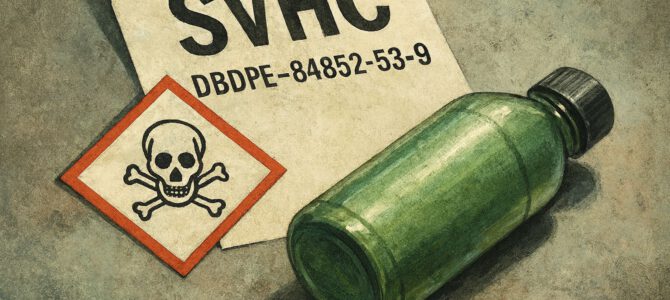
identified as a substance of very high concern (SVHC). This substance is characterized by very persistent and highly bioaccumulative properties.
DBDPE is a flame retardant additive used in plastics, textiles and electronics to increase fire resistance.
Companies may have legal obligations arising from the inclusion of a substance on the Candidate List. These obligations, which take effect from the date of inclusion on the list (November 5), apply not only to the listed substances on their own or in mixtures, but also to their presence in articles.
What does it mean?
Check whether DBDPE is present in your mixtures or products, and in what quantities. If it is present, you may have additional obligations, such as:
– notify the product to the SCIP database and to ECHA if the DBDPE content exceeds 0.1%
– update the safety data sheet for substances and mixtures containing DBDPE
– provide information on SVHCs in the supply chain with instructions on the safe use of the product
– provide information to consumers upon request
– possibility of including the substance on the REACH Authorization List
When you use our website, we may collect information to operate and improve your experience through cookies. By closing or accepting, you agree this use of cookies.